๐Ÿ”Œ Connector framework

Any system, in <5 minutes. Even the obscure ones.

Five built-in engines cover SCIM, LDAP/AD, Microsoft Graph, ServiceNow, and Salesforce out of the box. The 5-step wizard onboards any of them in under five minutes โ€” read-only by default, provisioning opt-in. Tier-3 hybrid agent keeps credentials in your VPC. And when you need an engine that doesn't exist yet โ€” adding one is days, not quarters.

What's inside

Vendor catalog, wizard, tier-3 agent โ€” and the framework underneath.

Most IGA tools sell you a connector library. We sell you the framework that makes new connectors a one-week project โ€” and a wizard that lets admins onboard them without writing code.

Vendor catalog
Connector catalog

7 SaaS apps via SCIM 2.0 โ€” live in <5 minutes

Slack, GitHub Enterprise, Atlassian Cloud, Okta SCIM apps, plus directories (Active Directory, OpenLDAP) and vendor-native engines (Microsoft Entra Graph, ServiceNow, Salesforce). One click on a vendor preselects the wizard with the right schema, suggested field mappings, and templates.
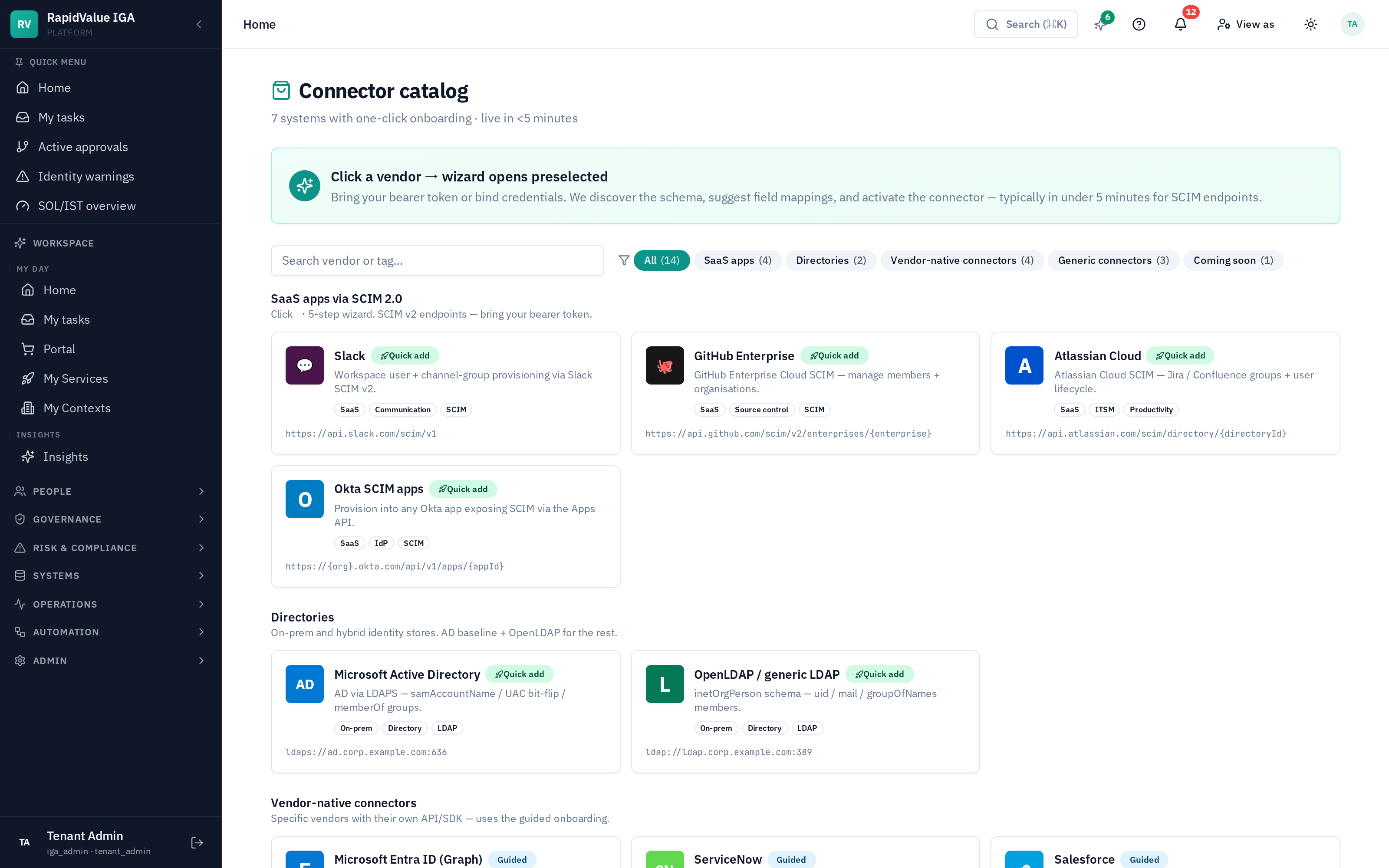
Connector catalog
Visibility-first onboarding

๐Ÿ‘๏ธ Read-only by default

New target connectors land in visibility mode โ€” sync identities, accounts, and entitlements without configuring write-back. You see your access surface immediately; provisioning is opt-in, per attribute.

โšก 5 minutes instead of 30

Skipping the write-path during initial setup means new targets onboard in ~5 minutes instead of ~30. Customers see the platform discovering their access before committing to provisioning mappings โ€” much faster path to "this is useful".

๐Ÿ”˜ Provisioning opt-in

Per-object write_enabled flag controls which targets accept write-back. Most demos start read-only across the board; customers enable writes for AD first (where the value is highest), then expand once they trust the platform.

๐Ÿ“Š IVIP mode for visibility-only tenants

Tenants on the ivip_visibility plan get the full governance read surface (identities, grants, SoD, risk score, recon) without any provisioning UI. Adopt RapidValue as your visibility layer first, expand to write-back when ready.

Real onboarding โ€” Microsoft Entra ID in 12 steps
Vendor template + connection test

From "click vendor" to "tested credentials" in 4 screens

Picking Entra ID in the catalog pre-loads the vendor template โ€” 6 object templates, default Graph endpoints, default auth method (OAuth2 client credentials). Steps 1โ€“6 are guided one-question-at-a-time. By step 7 the connection test runs against Graph and reports the count of accounts + entitlements found, plus a smart prompt: "is there an on-prem AD syncing into this tenant?" โ€” if yes, IGA auto-configures the routing.
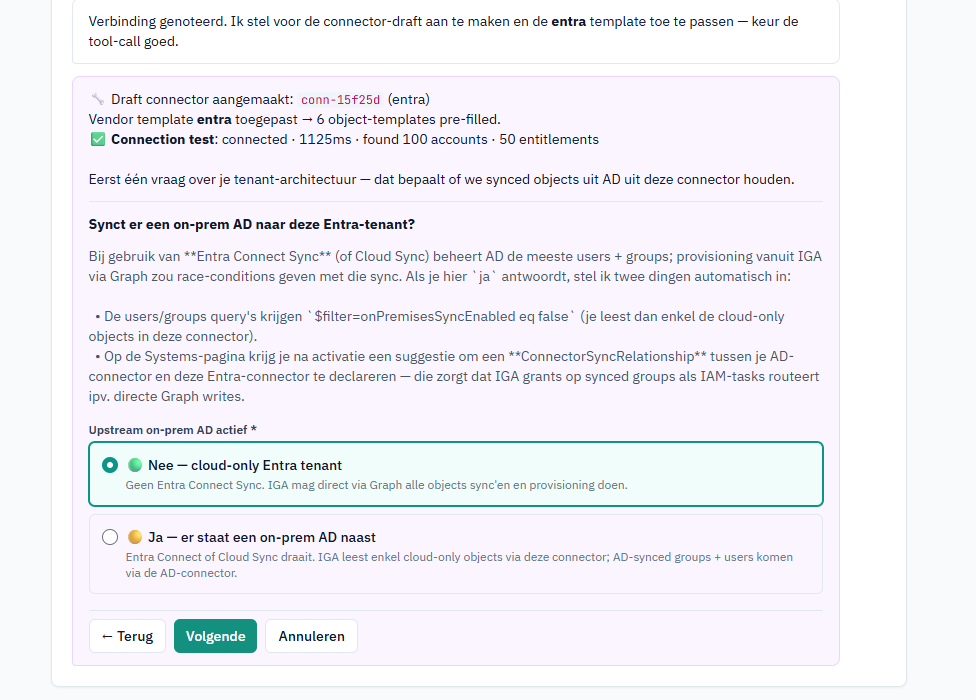
Entra connection test + sync strategy
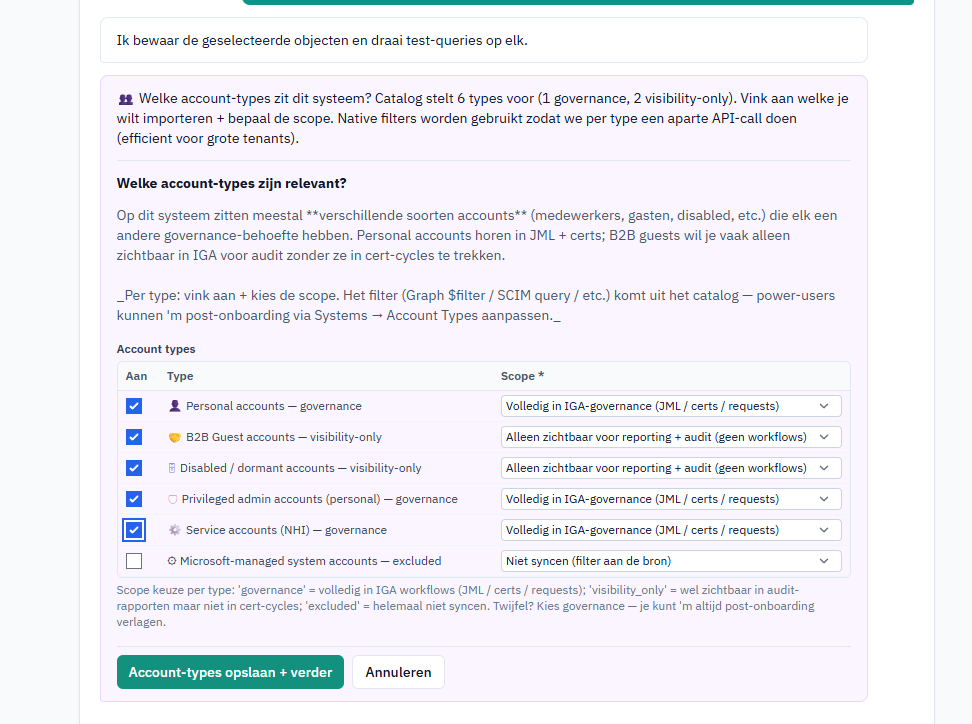
Account types with governance scope

Per-type governance โ€” not "sync everything"

Entra ID has 6 distinct account types (personal ยท B2B guests ยท disabled ยท privileged admin ยท service accounts ยท system accounts). The wizard asks which types you want and at which governance scope: full IGA workflows (JML + certs + requests), visibility-only (audit + reporting, no workflows), or excluded. Native Graph $filter generated automatically so each type is its own API call โ€” efficient at 50k+ tenants.

Entra account types
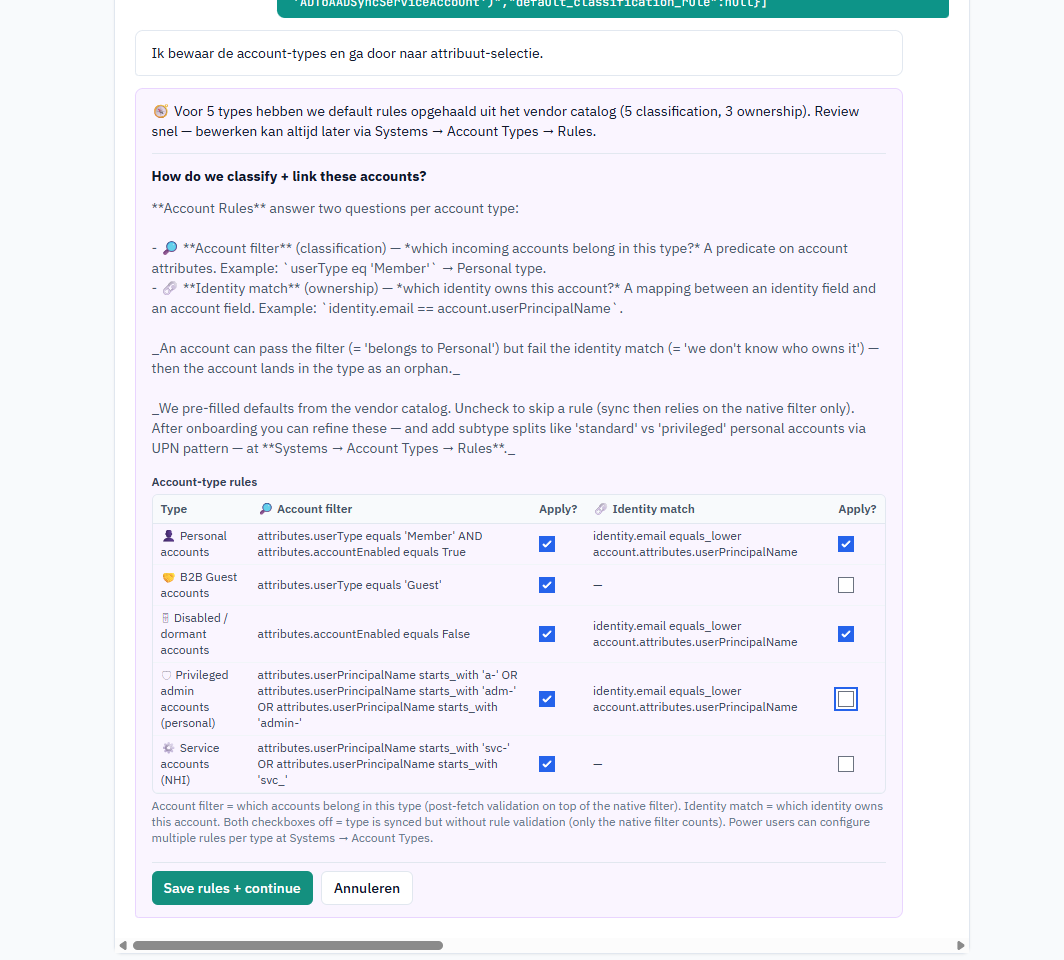
Account-type rules pre-filled

Classification + identity-match from the vendor catalog

For each account type the wizard pre-fills the classification filter (which accounts belong to this type) and the identity-match rule (which identity owns the account). 5 classification rules + 3 ownership rules populated automatically. Privileged admins detected by UPN prefix (a-, adm-, admin-). Service accounts (NHIs) detected by svc-/svc_ prefix. Refine post-onboarding via Systems โ†’ Account Types โ†’ Rules.

Entra account-type rules
Mappings + write operations

Standard + custom mappings ยท Jinja expressions ยท write-back

For each object the wizard generates standard attribute mappings (business_id, name, email, etc.) and supports custom mappings with Jinja expressions for derived values. By the activation step, 13 write-mappings + 3 lookups are configured for create / grant / revoke operations โ€” without you authoring a single line of JSON. Sync schedule defaults to 4-hourly (the IGA-healthy baseline).
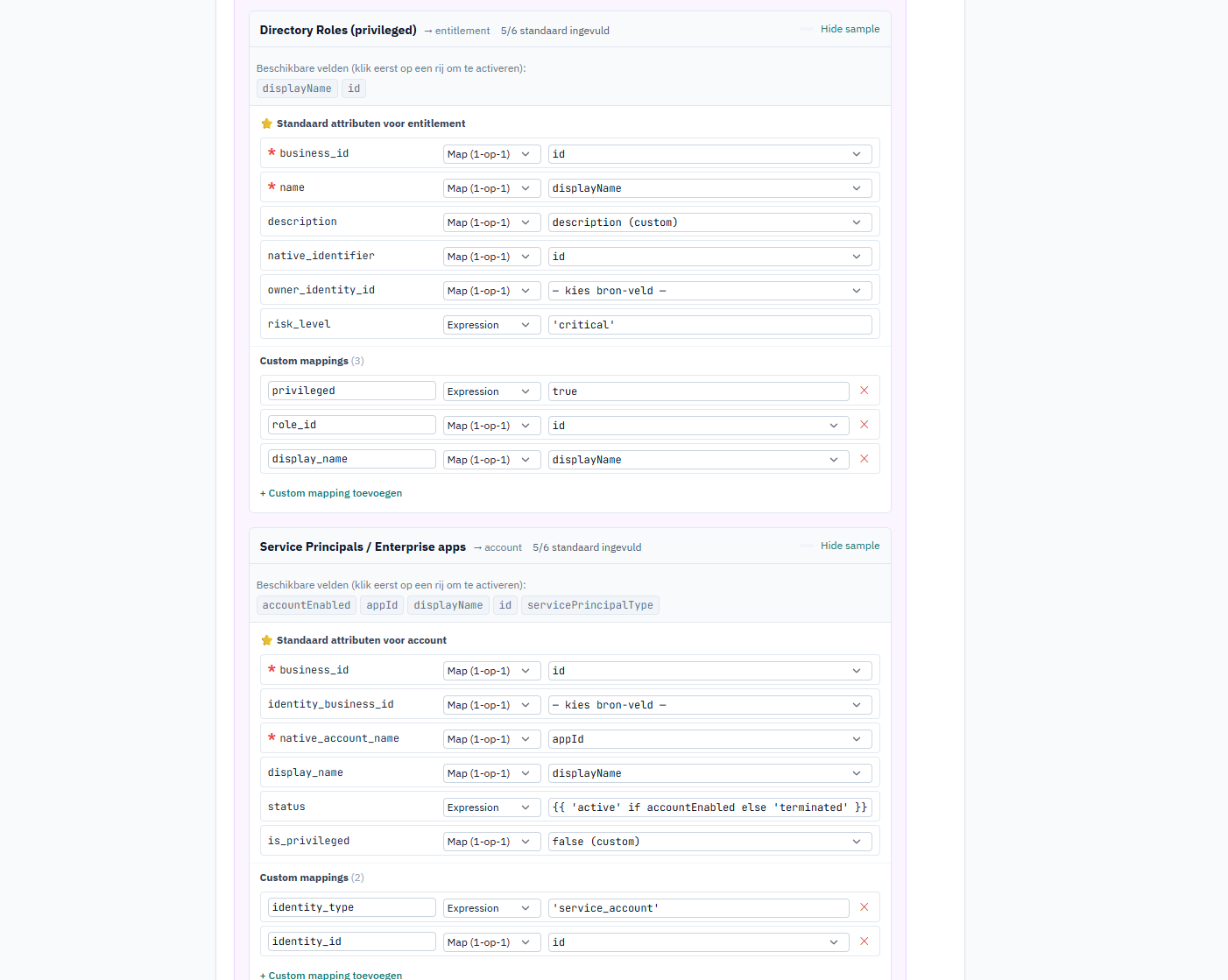
Entra mappings โ€” Directory Roles + Service Principals

See the full 12-screen walkthrough โ†’

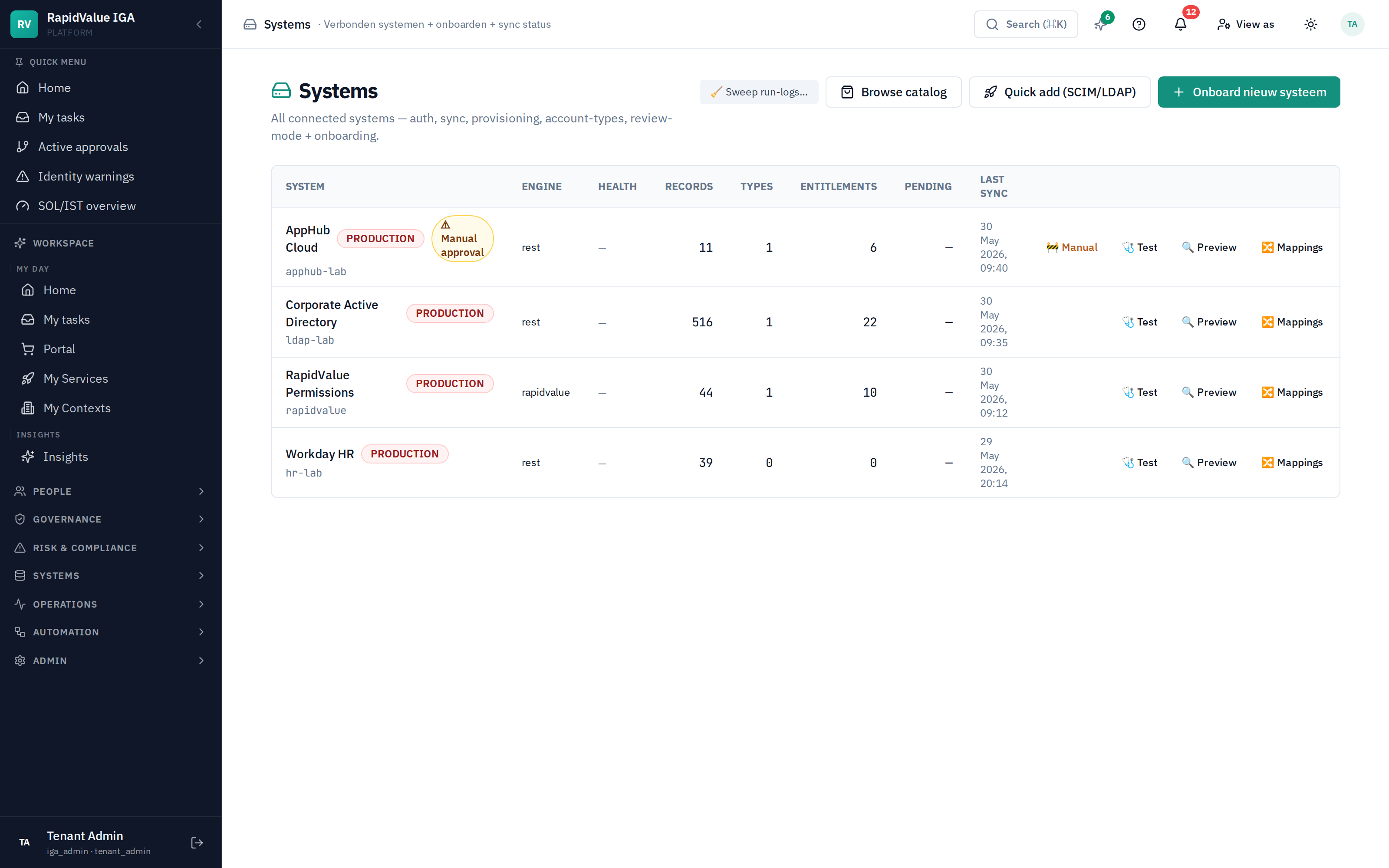
Systems overview
Systems

Every connected target โ€” one operational dashboard

See engine type, health, record count, entitlement count, pending items, last sync. Test, preview, or open mappings for any connector in one click. Onboard a new system from here too โ€” same wizard.

Systems
Sync overview

Schedule every connector โ€” see what's queued

Per-connector sync schedules (cron-style or interval). Live view of upcoming runs, last completion, and last error. Manual trigger from the dashboard for any system.
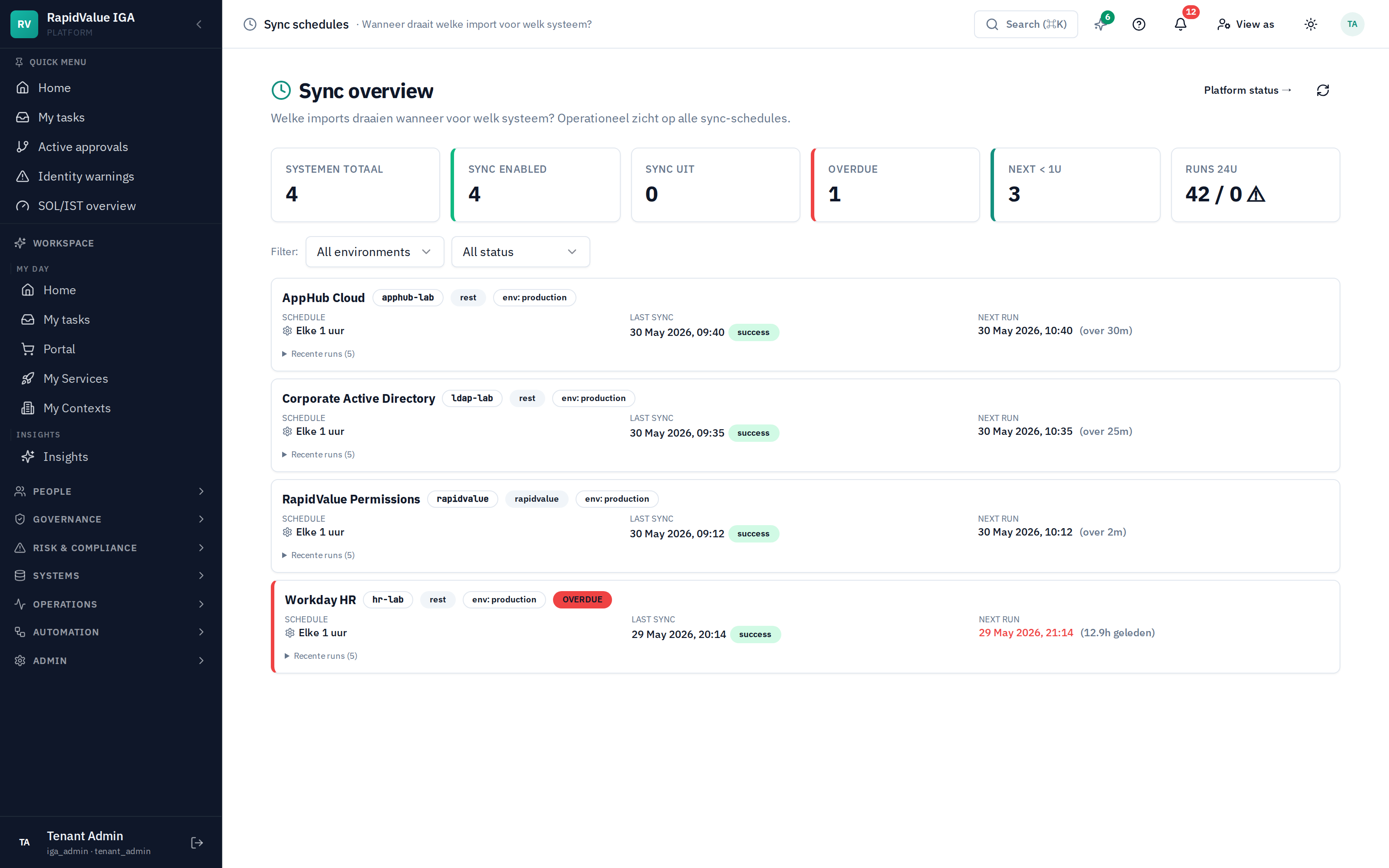
Sync overview
Schema registry & Quick Scan
Schema registry

Custom attributes, reference data, schema invariants

The schema registry holds tenant-defined custom properties (cost centers, locations, business units), reference catalogs that drive pickers across the UI, and schema invariants enforced at sync-time (e.g., "department must come from HR, never overridden by Entra").
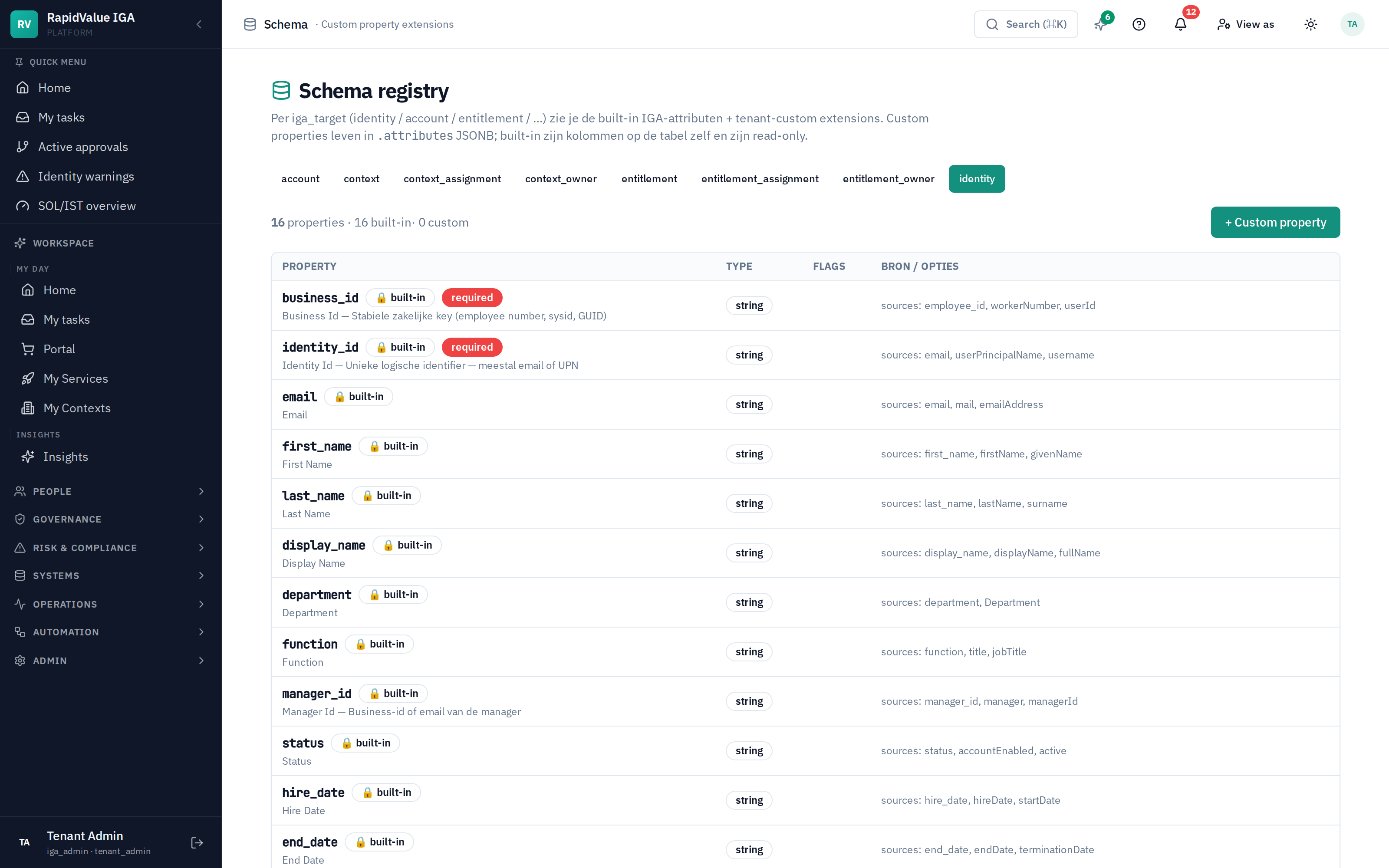
Schema registry
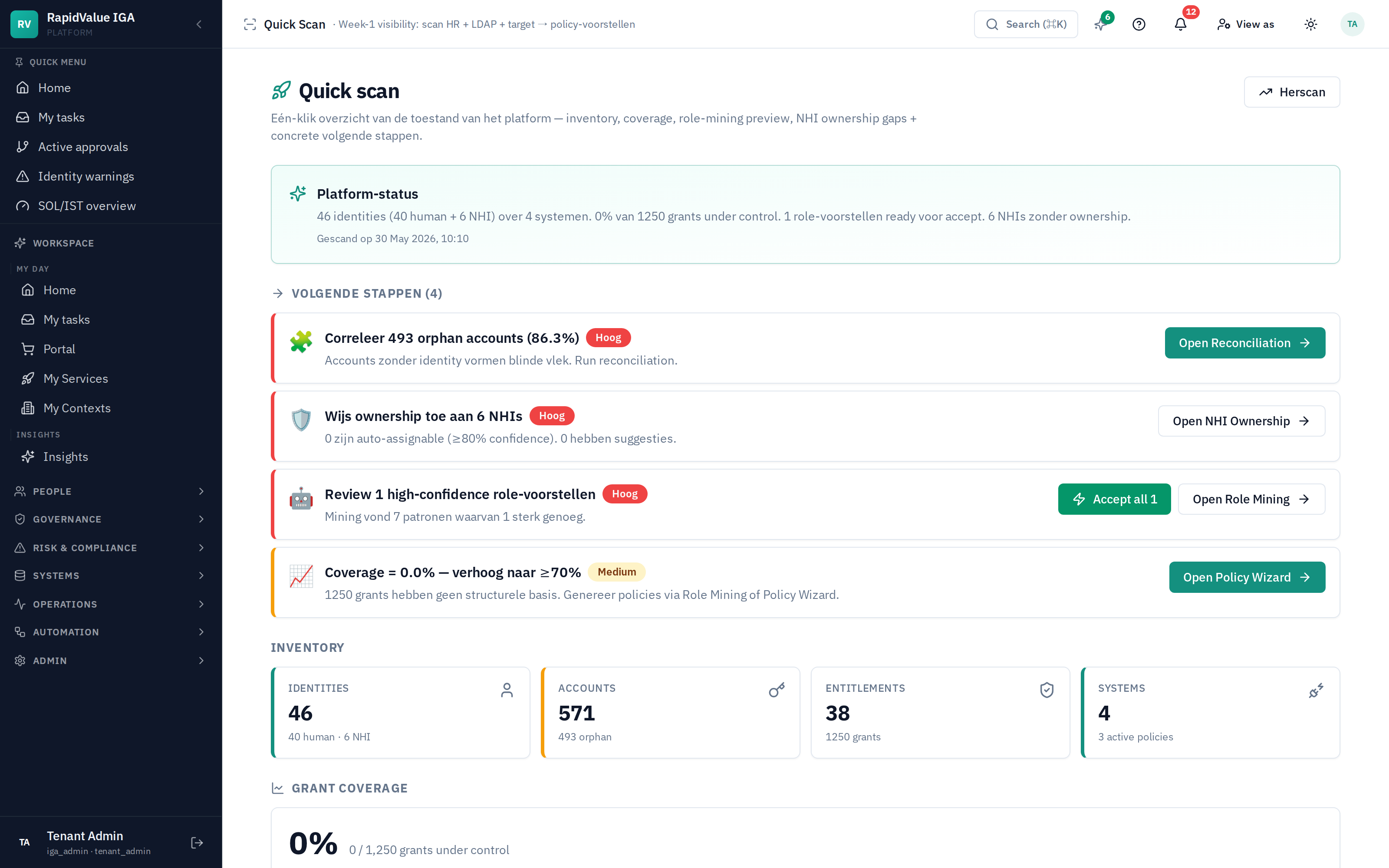
Quick Scan

Connect a system โ†’ see your governance gaps

After your first sync, Quick Scan tells you what's broken: orphan accounts, NHIs without owner, high-confidence role proposals waiting, coverage gaps. Each surfaced problem links to the page where you'd fix it. The fastest way to demonstrate value in a POC.
Quick Scan
Applications view
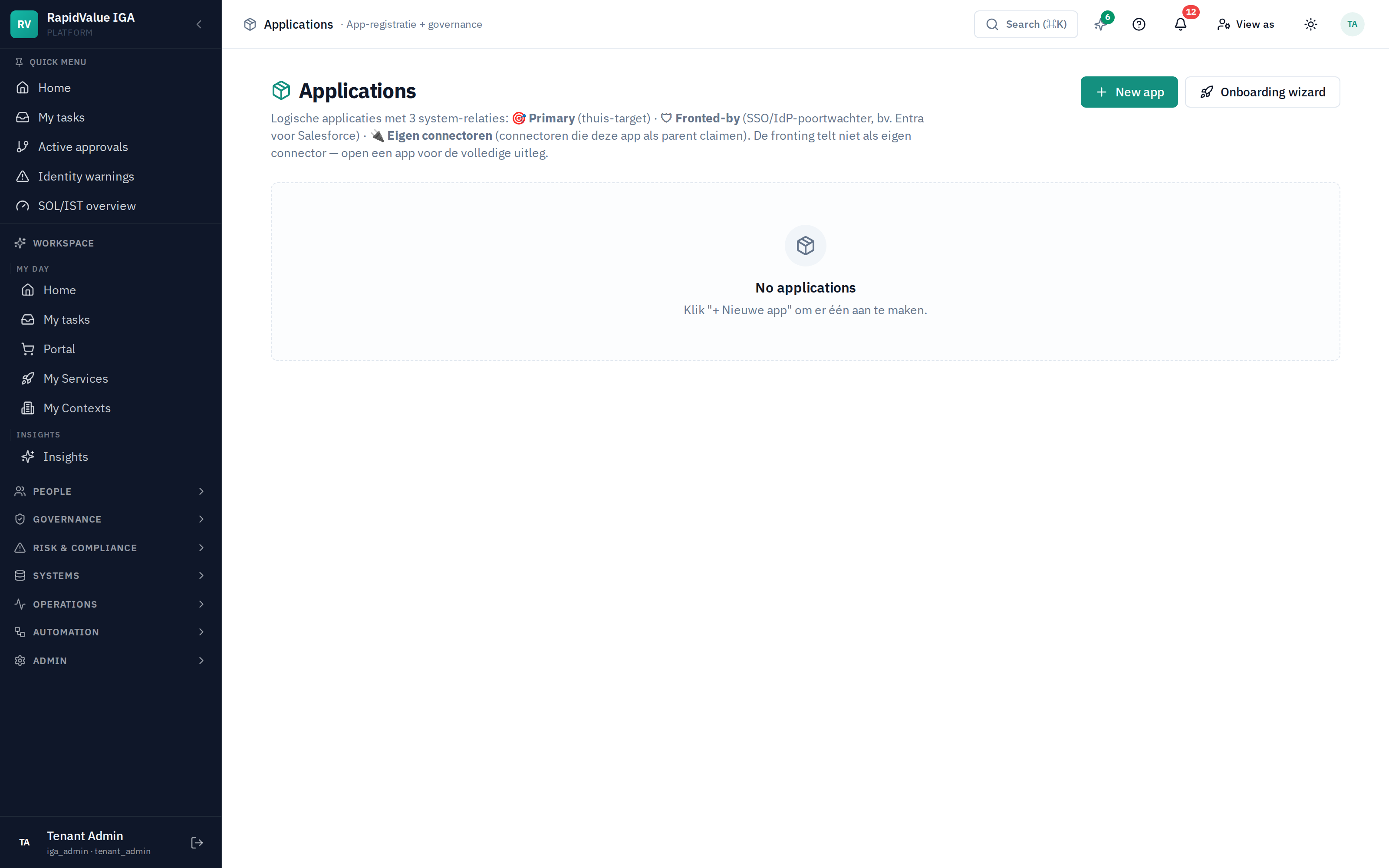
Applications

Business-meaningful application records

Applications wrap connectors with business metadata: owner, criticality, data classification, regulatory scope. One application can have multiple connectors (prod + staging + sandbox), and entitlements roll up to the application for cross-environment governance.
Applications

The framework underneath

Why extending RapidValue is a one-week project.

Classic IGA platforms ship monolithic connector codebases โ€” every new target means a vendor-side engineering project, multiple quarters of certification, and a per-connector licence fee. RapidValue's connector framework is a small protocol with five built-in engines that anyone can extend.

๐Ÿงฉ Pluggable Connector protocol

Every connector implements ConnectorProtocol v1 โ€” wire-stable schemas for list_identities, list_accounts, grant_group, revoke_group, etc. 19 methods total. Add a new engine by subclassing one base and implementing the methods your target supports.

โš™๏ธ Five built-in engines

RestEngine (generic REST + SCIM), LdapConnector (AD + OpenLDAP), EntraConnector (Microsoft Graph), ServiceNowConnector, and SalesforceConnector. Each covers a class of integrations โ€” most targets you'll ever want to onboard.

๐Ÿ“ Vendor templates

Templates encode the per-vendor specifics: endpoint paths, response shape, field-mapping aliases, write operations. New vendor on an existing engine = a JSON template, no code. Slack and Atlassian Cloud were added with template-only changes.

๐Ÿง™ Wizard for non-engineers

The 5-step wizard exposes engine config as guided questions: vendor, auth, schema, mappings, sync. Admins onboard systems without writing JSON. Auto-discovery + heuristic field mapping suggestions accelerate it.

Sovereignty by design

Tier-3 hybrid: credentials stay in your network.

For systems behind your firewall (AD, internal LDAP, on-prem ServiceNow, legacy REST APIs), our tier-3 agent runs in your VPC. Connector credentials are encrypted on the agent host and never transmitted to the control plane. Outbound HTTPS only โ€” no inbound ports, no VPN, no firewall exceptions.

๐Ÿ” Credentials never leave

The wire payload from control plane to agent carries only config (engine type, base URL, engine config). Auth config is resolved locally from agent-vault.json on the agent host. Master key can come from a local file, env var, or external secret store (Azure Key Vault, HashiCorp Vault).

๐ŸŒ Outbound HTTPS only

The agent connects out to the control plane on port 443. No inbound rules, no VPN tunnel, no extra software. SSRF guard on every tunnelled HTTP request โ€” the agent refuses any URL that doesn't match the configured connector base URL.

๐Ÿ”‘ Asymmetric keypair auth

ECDSA P-256 challenge-response โ€” the agent generates a keypair on first boot, registers the public key, and authenticates each session via signed nonce. Short-lived 4-hour access tokens. Bearer fallback remains for legacy bootstrap.

โšก WebSocket push + thresholds

WebSocket push notifications drop task latency from ~25s long-poll to near-zero. Provisioning thresholds (creates / updates / deletes per startup) protect against runaway operations โ€” the agent refuses to over-cycle a target system.

Why this matters in EU sales cycles

The classic IGA security review takes weeks. Ours takes minutes.

โฑ๏ธ Minutes-long security review

Customer security teams need to verify the agent is outbound-only, uses encrypted credentials, and runs in their network. They can read the open-source agent code in an afternoon. Classic vendors reach into your AD from their SaaS โ€” that's a multi-week review.

๐Ÿ‡ช๐Ÿ‡บ EU sovereignty out of the box

For German Mittelstand, French ETI, Dutch publieke sector โ€” "we don't send credentials to your cloud" is the kind of statement that closes deals. Tier-3 hybrid is the technical spec underneath that statement.

๐Ÿ“ฆ Walk-away clean

POC didn't convert? Kill the agent process. No formal decommissioning, no certificate cleanup, no IAM role review. Everything that lived in your network leaves with one systemctl stop.

๐Ÿ”„ Self-update with HMAC verification

Agents auto-update from a signed binary channel. Each release is HMAC-signed; the agent verifies before swapping. Rollback is one-line. No "VPN required to push the new agent" Friday evenings.

Onboard one of your real systems in under 5 minutes.

Bring credentials for any SCIM, LDAP/AD, Entra, ServiceNow, or Salesforce instance. We'll have it syncing identities into the demo environment before the demo call ends.

Book a POC demo โ†’
EU-hosted ยท No installation footprint ยท Walks away cleanly if you don't convert